

Few yoga postures transmit as much power as Virabhadrasana I. Strong legs, open chest, arms raised towards the sky. The whole body works in one direction: upward, forward, without hesitation.
But the warrior pose 1 does not speak of external battles. Its name hides one of the most intense legends of Hindu mythology, and its message is profoundly spiritual: the true struggle is against the ego.
Here you will discover the story of Virabhadra, how to execute this asana step by step, the mistakes you should avoid, and why this posture can transform both your body and your attitude towards life.
The Legend of Virabhadra: the Warrior Born from Shiva’s Anger
The name Virabhadrasana comes from Sanskrit: vira (वीर) means “hero” or “brave”, bhadra (भद्र) means “auspicious” or “blessed”, and asana (आसन) is “posture”. Virabhadra is, literally, the “blessed warrior”.
The story appears in the Shiva Purana, one of the great sacred texts of Hinduism. Daksha, a powerful king, organized a grand yagna: a fire ritual of immense cosmic importance. But he deliberately excluded Shiva and Sati, his daughter and Shiva’s wife.
Sati, devastated by her father’s disdain for Shiva, decided to attend the ritual alone. There, Daksha publicly humiliated Shiva before all the gods. Unable to bear the offense, Sati renounced the body her father had given her and immolated herself in the sacrificial fire.
When Shiva sensed Sati’s death, his pain was absolute. In his rage, he tore one of his matted locks and threw it to the ground. From that lock emerged Virabhadra: a colossal warrior with a thousand heads, a thousand arms, and weapons in each hand.
The three warrior postures: three moments of one story
The three variants of Virabhadrasana represent the three actions of this mythical warrior. In Virabhadrasana I, Virabhadra bursts forth from the depths of the earth with swords raised high, emerging with strength and determination. The uplifted arms, deep lunge, and gaze upward evoke that moment of arrival.
In Virabhadrasana II, the warrior halts, extends the arms, and fixes his gaze on his target: Daksha. In Virabhadrasana III, he delivers the final blow and beheads him.
But the legend does not end in destruction. Shiva, after calming his anger, gave life back to Daksha by placing a goat’s head on him. And Sati was reborn later as Parvati to reunite with Shiva.
The message is clear: Daksha symbolizes ego, pride, and attachment to social status. Virabhadra is not a warrior who fights against others, but the inner warrior who cuts off arrogance, ignorance, and false perceptions of the conditioned mind at the root.
How to do Virabhadrasana I step by step
Follow these instructions to practice the Warrior 1 pose with safe and effective alignment:
- Start from Tadasana. With your feet together, activate your legs, elongate your spine, and breathe deeply. Center your attention before beginning the movement.
- Step back long. Move the left foot back about one to one and a half meters. Turn the back foot out about 45-60 degrees. Make sure your feet are not in the same line: keep them hip-width apart to provide stability to the pelvis.
- Flex the front knee. Bend the right knee until the thigh is as parallel to the ground as possible. The shin should be vertical, with the knee directly over the ankle. Never let the knee go past the toes.
- Root the back foot. Press firmly the outer edge of the left foot and the heel against the mat. If the heel lifts, shorten the distance between your feet until you can keep it on the ground.
- Align the pelvis forward. Try to direct both iliac crests towards the front of the mat. Do not force: bring the pelvis as far as your anatomy allows without compromising the knee or lower back.
- Raise the arms. Inhale and lift the arms alongside the ears, with the palms facing each other or together. The shoulders drop away from the ears. Fully extend the elbows and stretch the fingers toward the ceiling.
- Lengthen the spine. From the pelvis to the crown, grow upward. Gently activate the abdomen to prevent excessive arching in the lower back. The sternum rises, the lower ribs do not flare.
- Direct your gaze. If your neck allows, slightly lift your gaze upward, towards your hands. If you have cervical discomfort, keep your gaze forward, at horizon level.
- Respire and hold. Hold the position for 5 to 10 deep breaths. Afterwards, repeat on the other side.
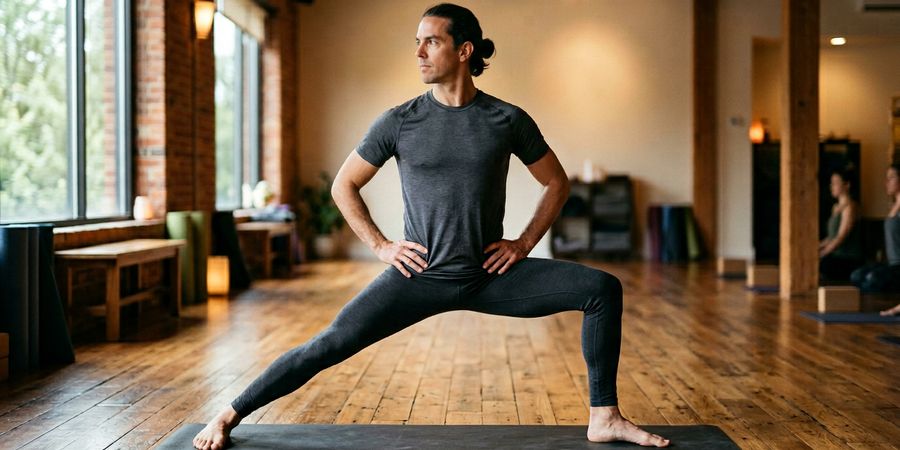
Correct Alignment: Common Mistakes and How to Fix Them
Virabhadrasana I is a deceptively complex pose. It combines hip flexion in the front leg, hip extension in the back leg, spinal extension, and full shoulder flexion—all at the same time. These are the most frequent mistakes and how to resolve them.
Hips and Legs
The most debated mistake is the orientation of the pelvis. The classic instruction asks to “square the hips forward,” but anatomically this is impossible for most bodies. The hip joint has a bony limit that varies from person to person.
The solution is not to force. Press the back foot against the mat and try to “drag” that foot towards the midline without actually moving it. This activates the adductor longus of the back leg and rotates the pelvis forward in a mechanical and safe manner.
Another classic: the front knee collapses inward (valgus). This creates dangerous stress on the medial collateral ligament. To correct this, press the outer edge of the front foot against the ground and actively direct the knee towards the little toe of the foot.
It is also common for the back heel to lift off the ground, turning the posture into a high lunge (Ashta Chandrasana). If you want to practice Virabhadrasana I, shorten the distance between the feet and increase the angle of the back foot until the heel settles.
Column and upper body
The lumbar hyperextension is the most common mistake in the upper part. When raising the arms, the lower back tends to arch excessively, compressing the L4-L5 vertebrae. The cause is usually the tension of the psoas in the back leg, which pulls the pelvis forward.
To correct it, activate the transverse abdominal by gently drawing the navel towards the spine. Lengthen the coccyx towards the floor instead of letting it rise backward. The sign that you are doing it correctly is feeling space between the lower ribs and the pelvis.
Finally, the shoulders that rise towards the ears generate unnecessary tension in the upper trapezius and neck. Exhale, lower the shoulder blades and broaden the collarbones. The arms should feel like a natural extension of the spine, not like an isolated effort.

Benefits of Virabhadrasana I
Physical Benefits
The quadriceps, hamstrings, glutes, and adductors work intensely to support the deep lunge. The sustained isometric contraction of the knee at 90 degrees makes Virabhadrasana I one of the most effective yoga poses for strengthening the legs.
The back leg experiences one of the deepest psoas stretches offered by yoga. Since the hip flexors shorten with the hours we spend sitting, this pose acts as a direct antidote against that stiffness.
The chest expands, the shoulders retract, and the thoracic spine extends. This counteracts kyphosis (rounded shoulders forward), one of the most frequent postural consequences of sedentary work in front of the computer.
Furthermore, maintaining a neutral pelvis while the hip flexors are under stretch requires a deep core activation. The transversus abdominis works as a natural corset that protects the lumbar area and stabilizes the whole structure.
Energetic and Mental Benefits
Virabhadrasana I particularly connects with Manipura, the solar plexus chakra, associated with willpower, personal power, and inner fire (agni). It is the pose that tells you: “you can hold yourself, you can move forward, you can face whatever comes.”
An open chest and an elevated gaze also stimulate Anahata, the heart chakra. There is a brave vulnerability in exposing the chest and lifting the gaze. It is strength combined with openness, power with sensitivity.
At a mental level, holding the pose for several breaths trains endurance and concentration. The legs tremble, the effort increases, and the mind seeks excuses to leave. To remain is to practice tapas: the burning discipline that the Yoga Sutras of Patanjali describe as essential for transformation.
Variations and modifications
Virabhadrasana I is suitable for all levels. The key is to choose the variation that allows you to work with good alignment and without pain.
For beginners
Hands on the hips. Removing the arms over the head reduces cardiovascular demand and allows focus solely on the alignment of the legs and pelvis. It is the best option for those learning the pose or who have shoulder limitations.
Shorter lunge. Reducing the distance between the feet decreases the demand on the hip flexors and facilitates the orientation of the pelvis. The posture retains its structure; only the depth changes.
Cushion under the back heel. If the heel does not reach the ground due to tension in the gastrocnemius or Achilles tendon, place a folded blanket or a yoga cushion underneath. This support allows the entire posterior chain of the leg to activate without compromising the posture.
To deepen
High Lunge (Ashta Chandrasana). Keeping the back heel elevated with the knee extended greatly aids in orienting the hips forward. It’s a legitimate and powerful variation in its own right, ideal as a precursor to the full expression with the heel on the ground.
Humble Warrior (Baddha Virabhadrasana). Interlace the hands behind the back and bend the torso inward toward the front knee while raising the arms behind you. Add external rotation of the shoulders, chest opening, and a forward bending component.
Cactus arms. Elbows bent at 90 degrees at shoulder height, palms facing forward. Reduces shoulder strain while maintaining thoracic opening. Excellent option for individuals with rotator cuff issues.

Contraindications
Virabhadrasana I is a safe posture for most practitioners, but there are situations where it is advisable to modify or avoid it.
If you have uncontrolled high blood pressure, the position with arms overhead may temporarily raise blood pressure. Practice with hands on the hips or at chest level in Anjali mudra.
In case of knee injuries (meniscus, cruciate ligaments, patellofemoral syndrome), reduce the depth of the forward bend, shorten your stride, and do not allow the knee to go beyond the ankle. If there is active inflammation, avoid the pose completely.
In case of hip problems such as femoroacetabular impingement or recent prosthesis, do not force the orientation of the pelvis forward. Allow the back hip to remain more open and respect the range of motion that your body offers you.
If you have cervical discomfort, do not look upwards. Keep your eyes forward or slightly down. Cervical compression from a forced neck hyperextension can worsen existing problems.
During pregnancy, starting from the second trimester, widen your base of support, reduce the depth of your stride, and consider practicing with your hands on your hips instead of raised.
The inner warrior: why Virabhadrasana I transforms your practice
Virabhadrasana I is not just a strength pose. It is a reminder that you can face discomfort without fleeing from it. Each time your legs shake and you decide to stay for one more breath, you train the quality that yogis call tapas: the inner fire of discipline.
In the sequences of Ashtanga Vinyasa, it appears in the primary series just after Utkatasana. In Hatha classes, it is the center of gravity of any standing pose sequence. There is no complete practice without going through the warrior.
What you learn here transfers to everything else. The leg activation you develop will be needed in Trikonasana. The chest opening will prepare you for deeper extensions like Ustrasana. And the mental endurance that you cultivate will be your greatest ally in the most challenging poses of your journey.
If you want to master this and other fundamental postures with guidance from teachers trained in the Indian tradition, our yoga teacher training course dedicates complete modules to anatomical analysis and the deep practice of each asana.


